Together AI has launched Together Link: a free, MIT-licensed CLI that reroutes popular coding agents — including Codex, Claude Code, OpenCode, and ChatGPT Desktop, to open models hosted on its platform. It’s live now, installable in one command on macOS or Linux, and requires only a Together API key. No local proxy.
No daemon. No setup beyond that. And it bills per token, with real-time spend tracking built into every session. This isn’t a sandbox experiment.
It’s a production-ready cost switch for developers already using these tools daily. The headline move? Codex no longer talks to OpenAI’s servers. It talks to GLM 5.3, Kimi K3, or DeepSeek V4.1 Flash.
All with 1M context, via Together’s gateway. And yes, that includes the Codex CLI. That’s the phrase people are searching for: codex cli. Now it’s open, local-model-aware, and priced transparently.
GLM 5.3 costs $1.40 per million input tokens and $4.40 per million output tokens. DeepSeek V4.1 Flash is $0.30/$1.20. Kimi K3 is $3.00/$15.00. All rates are pay-as-you-go, billed against your existing Together account.
Each terminal session prints final token counts and dollar totals on exit. In Claude Code, the status bar shows estimated spend beside what the same task would cost on Opus 5.5. A side-by-side cost audit, baked in. Routing is adaptive: the first prompt determines the model tier.
Quick edits go to GLM 5.3 Flash. Complex refactors route to Kimi K3. You can override it with flags like togetherlink --main zai-org/GLM-5.3 codex. Shortcuts exist: tcodex launches Codex with Together routing. tclaude does the same for Claude Code.
The installer adds Bun if missing and drops binaries in ~/.local/bin. Profiles for Claude Desktop and ChatGPT Desktop are reversible, togetherlink chatgpt off flips back instantly. No data leaves your machine beyond the prompts you send. Together says it serves 40.8% of all OpenRouter traffic for DeepSeek V4.1 Flash, 28.2% for GLM 5.3 Flash, and 23.1% for Kimi K3.
Figures current as of 30 September 2026. This isn’t about replacing closed models outright. It’s about giving engineers a one-command escape hatch from runaway LLM bills, especially when the work doesn’t need frontier capability. Codex users who’ve been paying OpenAI’s per-session fees for routine linting or docstring generation now have a direct, auditable alternative.
The beta is live. The pricing is public. The CLI is MIT-licensed. And the first togetherlink codex command runs today.
ADFiled by The AI Desk
Models, assistants and the companies and chips behind them, reported from what was released and what was claimed, with the difference kept clear.
More from this desk →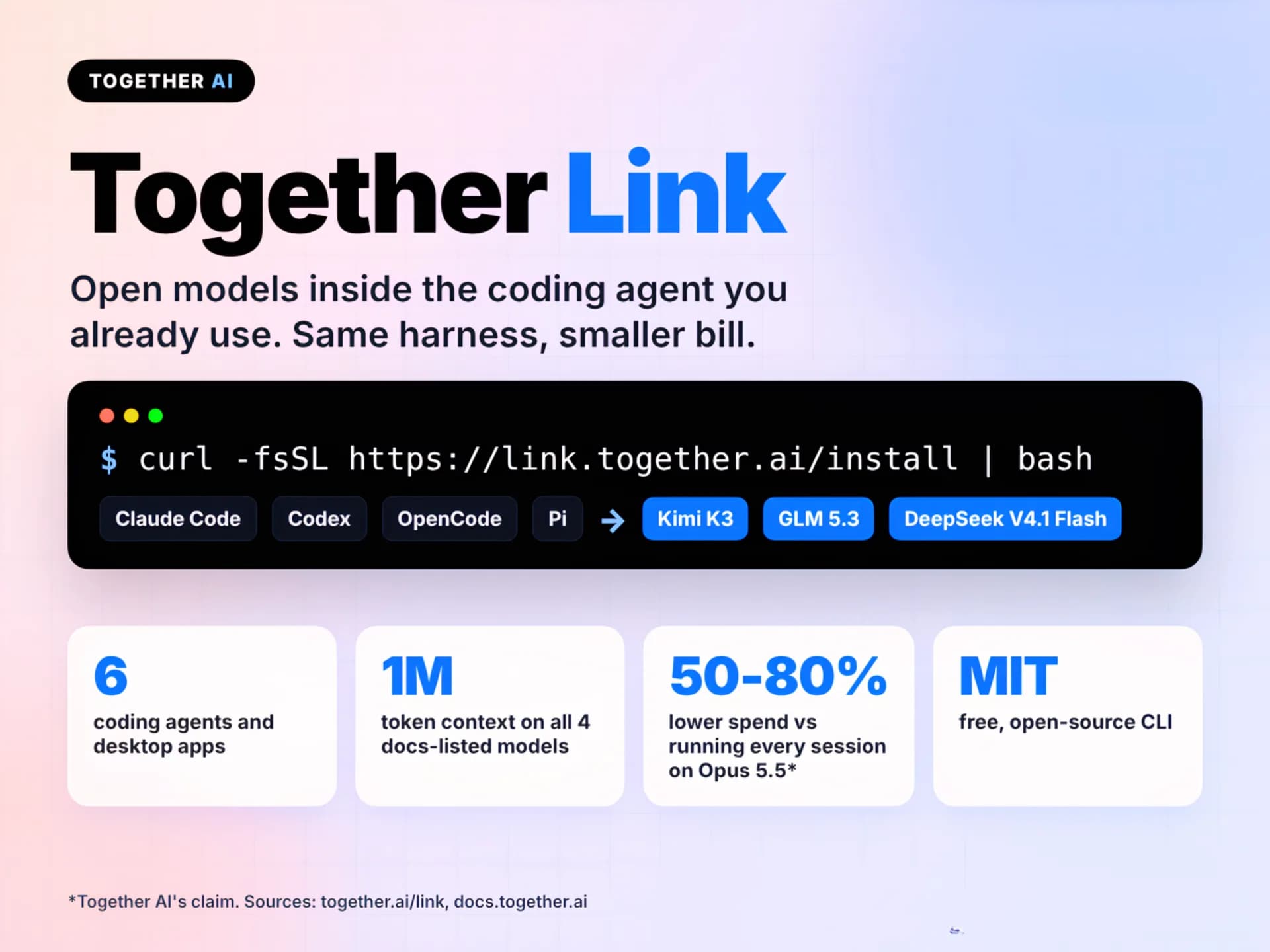

Be the first to comment
Join the argument. No password, just your email or a passkey.