Samsung’s Galaxy Z Fold 8 is now live — and SamMobile’s Mihai positions it not just as a new device, but as a quiet rebuttal to Apple’s freshly launched iPhone Duo. The two represent divergent philosophies for the foldable category: symmetry versus asymmetry. The Fold 8 keeps its symmetrical cover screen, equal top and bottom bezels, square corners on both displays, and hardware placement built around balanced, two-handed use.
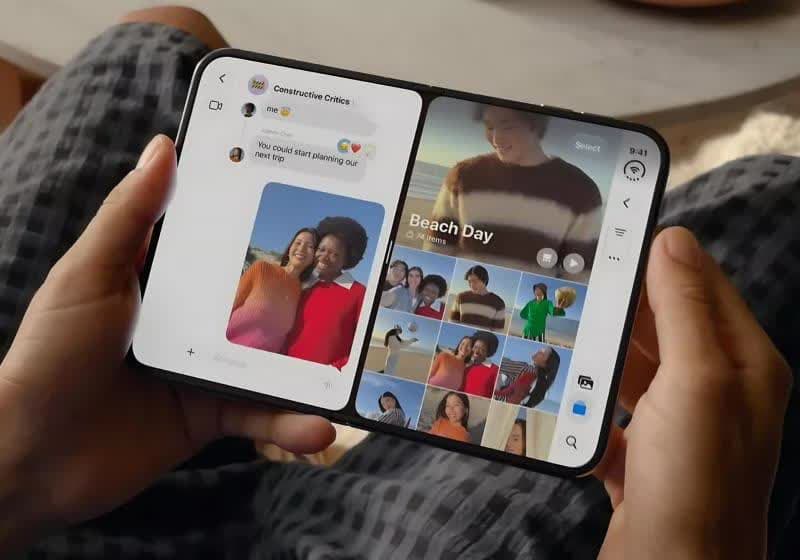
Apple’s iPhone Duo, by contrast, features an asymmetrical cover screen: wider on the right, narrower on the left. A layout SamMobile says reflects Apple’s struggle to reconcile the rounded aesthetics of recent iPhones with the more rectangular language of iPads. That tension, the piece argues, forced a compromise. ‘Apple had fewer choices if it wanted to create a foldable iPhone that looked consistent with the rest of iPhones and iPads,’ Mihai writes.
Its other option, he notes, would have been to follow Google’s Pixel Fold series, but it didn’t. Instead, Apple leaned into iPad familiarity, even at the expense of iPhone consistency. The result is a device whose cover screen feels less like a phone and more like a tablet fragment. And whose software response is equally tailored.
IOS introduces a new on-screen control surface for the iPhone Duo, including a repositioned app dock meant to make the asymmetry feel purposeful. But SamMobile calls that solution ‘compromised’, because it was designed ‘primarily, or solely. With right-handed users in mind’. That’s a notable departure, the article stresses, from Apple’s usual attention to inclusivity.
Samsung isn’t perfect either: the side-mounted fingerprint sensor still favours the right thumb. But beyond that single point, the Fold 8’s symmetry extends across hinge alignment, camera housing geometry, and main display proportions, all calibrated so the transition between folded and unfolded states feels coherent, whether you’re holding it in your left or right hand.
SamMobile doesn’t call the Fold 8 flawless. It notes ‘first-gen’ quirks like speaker placement and camera housing design, but argues those are refinements, not foundational flaws. The iPhone Duo, by comparison, feels ‘almost like a prototype at times’ due to its core ergonomic trade-off. The piece closes with a clear directive: Samsung should keep iterating on the Fold formula.
Improve the speakers, refine the camera bump, but resist copying Apple’s asymmetry. ‘Symmetry seems to work best for this category of foldables, especially for Samsung,’ Mihai concludes. And the Fold 8, he says, proves why.
MDFiled by The Mobile Desk
Phones from leak to launch to price cut: what was announced, what it costs where, and when it goes on sale. Indian launches and prices included, not appended.
More from this desk →

Be the first to comment
Join the argument. No password, just your email or a passkey.