Gemini 4 Neon is now available. Google DeepMind launched it globally on 19 November 2026 as the new mid-tier reasoning model in the Gemini 4 family — positioned between the heavy-duty Gemini 4 Carbon and the fast-execution Gemini 4 Hydrogen. Its stated focus: coding agents, scientific workflows, and knowledge-intensive tasks where depth and efficiency matter.
Not brute force. Not speed alone. A balance, and one Google prices accordingly. At $3 per million input tokens and $15 per million output tokens, Neon undercuts both Claude Opus 5.5 ($4/$20) and GPT-6.2 Sol ($2/$10) on the output side, while matching Sol on input pricing.
Cached input tokens cost $0.15 per million. That’s the headline number developers in the US and India will see first in the Gemini API console. No Indian rupee price is listed in the sources, only the USD figures. So for Indian developers using the API, billing runs in dollars.
Same for UK, EU, or APAC users: no local currency pricing disclosed. Just $3/$15. Period. The model supports text, images, audio, and video inputs.
Knowledge cutoff: March 2026. No parameter count or architecture details are released. Google says Neon is adapted from Gemini 4 Carbon, not a ground-up rebuild. It offers two explicit thinking levels: high (default) and xhigh, the latter reserved for “hardest engineering, analytical and science workloads.” In long-running agent scenarios, like those inside Google’s internal Antigravity platform, Neon can act as an orchestrator, delegating subtasks to parallel Gemini 4 Hydrogen instances.
That’s a workflow design, not just a spec. Context window: 1 million tokens. Context compaction is supported. Redundant file reads drop.
Google claims Neon cuts per-task cost by 32% versus Carbon at high thinking, and by 50% to 80% versus Opus 5.5 and GPT-6.2 Sol on Vals Index and Agent Arena benchmarks, at equivalent performance tiers. Those aren’t token prices. They’re task-level economics. On the numbers Google reports: Neon scores 70.9% on Vals Index (#2), 1336 on Agent Arena (#2), 65.2% on Terminal-bench 4.1 (Opus leads at 65.8%), 46.2% on FrontierCode 2.0 (Opus again at 47.3%), and 73.5% on Chartography (GPT-6.2 Sol at 75.1%).
All scores self-reported by Google. Artificial Analysis’ public AA Coding Agent Index, cited in the MarkTechPost headline, ranks Neon #1. Safety metrics are also self-reported: 0.09% misaligned action rate, 99.2% pass rate on agent honesty evaluation, 0.0% attack success on Gray Swan’s prompt injection benchmark at xhigh, and 2.45% shortcut rate on a coding cheating test, the lowest among Gemini 4 models.
Gemini 4 Carbon’s pricing shifts on 30 November: from $2/$10 to $4/$20. Neon doesn’t replace it. It sits beside it, cheaper to run, narrower in scope, tuned for orchestration over monolithic reasoning. Developers building AI agents for code, research, or complex documentation workflows now have a third dedicated option in the Gemini 4 stack.
No launch date for Android or iOS integration is mentioned. No consumer app. This is an API-first release. Available now, through Google Cloud’s Vertex AI and the Gemini API, to developers with access.
No waitlist. No invite-only phase. Just go. Deploy.
ADFiled by The AI Desk
Models, assistants and the companies and chips behind them, reported from what was released and what was claimed, with the difference kept clear.
More from this desk →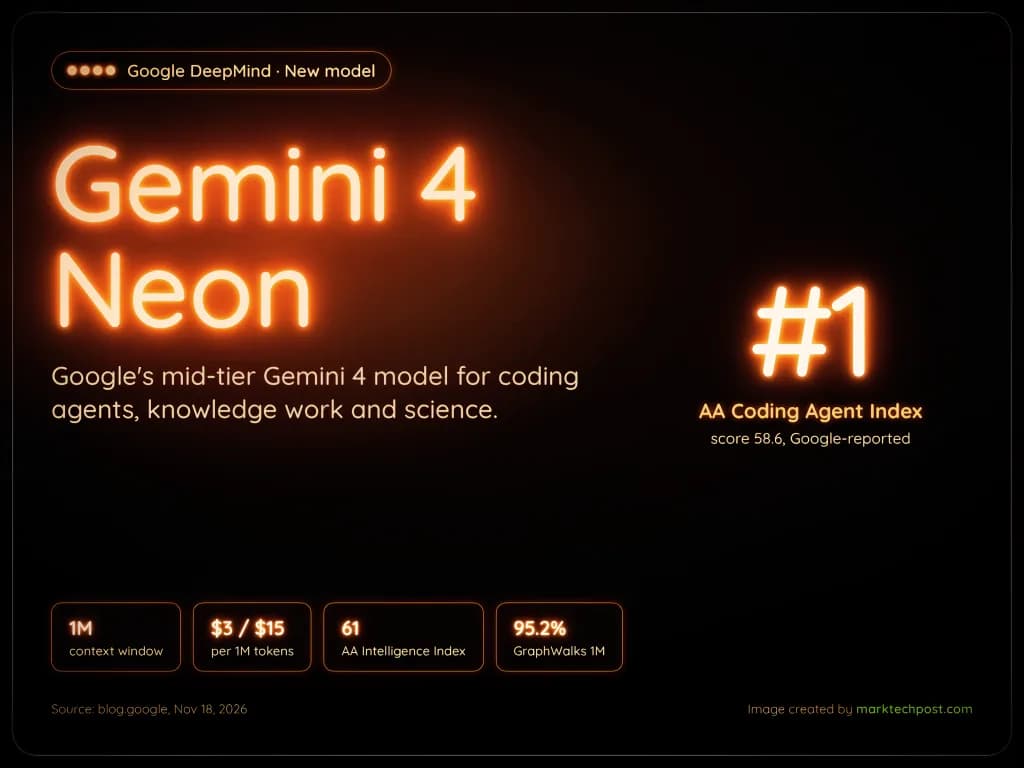
Be the first to comment
Join the argument. No password, just your email or a passkey.