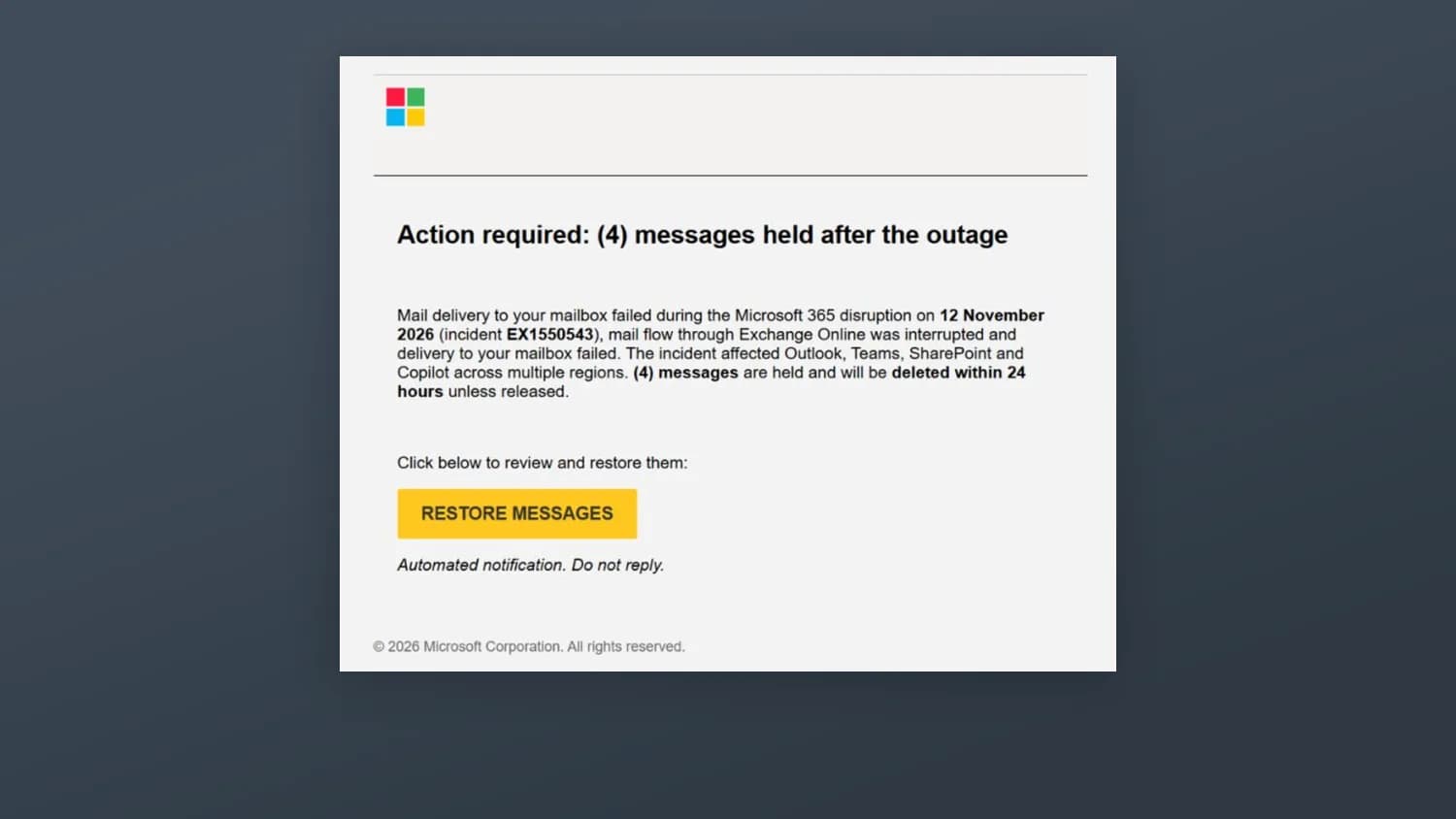
Microsoft Outlook and Microsoft 365 services went down globally for 24 hours on November 12. The outage is over. The phishing scams exploiting it are not. The fake emails use Microsoft’s real incident number — EX1550543, and mimic official service alerts so closely that they name the affected service (Exchange Online), cite a plausible timeline (“messages will be deleted in 24 hours”), and even spoof sender names tied to the recipient’s organisation.
Subject lines start with ‘Outage’ followed by a six-character code. Domains used include moments-notice.com, planetmaison.com, and newbooker.com. Microsoft Threat Intelligence confirmed the campaign but said it has no evidence yet that credentials were stolen or malware deployed. No price, no launch, no spec sheet, just a post-outage security alert with teeth.
This isn’t about new features. It’s about what happens when a global email backbone fails, and criminals move faster than the patch notes. Microsoft tells users to ignore any ‘restore your messages’ link, and check status only via the official Microsoft 365 admin center or the public Microsoft 365 status page.
Organisations without admin access should treat every unsolicited ‘Outage Notification’ email as hostile, even if it looks like it came from IT. The next step isn’t a firmware update. It’s training, vigilance, and verifying before clicking. Microsoft’s own status page remains the only trusted source, and it’s still up.

Be the first to comment
Join the argument. No password, just your email or a passkey.