Windows 11 Pro — and all editions supporting Windows-managed USB4, will soon be able to treat multiple consumer PCs as a single, distributed AI inference machine. Microsoft announced RDMA over USB4 on Friday, an experimental feature that lets compatible systems share GPU memory and processing across ordinary USB4 or Thunderbolt 4 cables, bypassing the OS networking stack entirely.
No switches. No NICs. No InfiniBand. Just cables you already own, if your hardware qualifies.
The tech relies on Remote Direct Memory Access (RDMA), long confined to enterprise servers and HPC clusters. Microsoft has ported it to USB4 using its existing NetworkDirect interface and a new software-based RDMA provider. Early tests show round-trip latency of 28–50 microseconds for small messages, roughly 4× faster than UDP over Ethernet-on-USB4.
That speed holds across both 40 Gbps and 80 Gbps links, though bandwidth doubles at the higher spec. AMD demonstrated it with three mini PCs, each packing a Ryzen AI Max+ 395 CPU, Radeon 8060S GPU, and 128 GB of unified memory. Connected in full-mesh USB4 40 Gbps, they ran Qwen3-235B-A22B, a 235-billion-parameter mixture-of-experts model, at 18.5 tokens per second using 4-bit quantization.
AMD’s own measurements hit 21.98 tokens/sec during decoding and 117.98 during prompt processing. Intel showed similar scaling: three Core Ultra Series 3 PCs (64 GB RAM each, Thunderbolt 4) ran GPT-OSS-120B at 49.4 tokens/sec. Adding a fourth pushed it to 54.2, even though the 120B model won’t fit in one system’s memory alone.
This isn’t plug-and-play. It requires Windows-managed USB4 at 40 Gbps or faster. Full-mesh topology is strongly recommended, every PC must connect directly to every other, no daisy-chaining. Apps must explicitly support distributed execution.
Microsoft has released an open-source NetworkDirect provider and a modified llama.cpp implementation as proof points. The feature lands first in a forthcoming Windows Insider Experimental Channel (Future Platforms) build. It’ll be disabled by default. Enabling it requires Registry edits and test signing, which, for now, means disabling Secure Boot.
Microsoft explicitly warns against trying this on primary machines. There’s no public release date. No word on whether it’ll ship in Windows 11 Pro, Enterprise, or any SKU beyond Insider builds. What it does signal is clear: Microsoft is treating local AI less as a single-device problem and more as a networked one, starting not with custom silicon or proprietary interconnects, but with the ports already on your desk.
CDFiled by The Computing Desk
Laptops, desktops, processors, graphics cards and the operating systems that run on them.
More from this desk →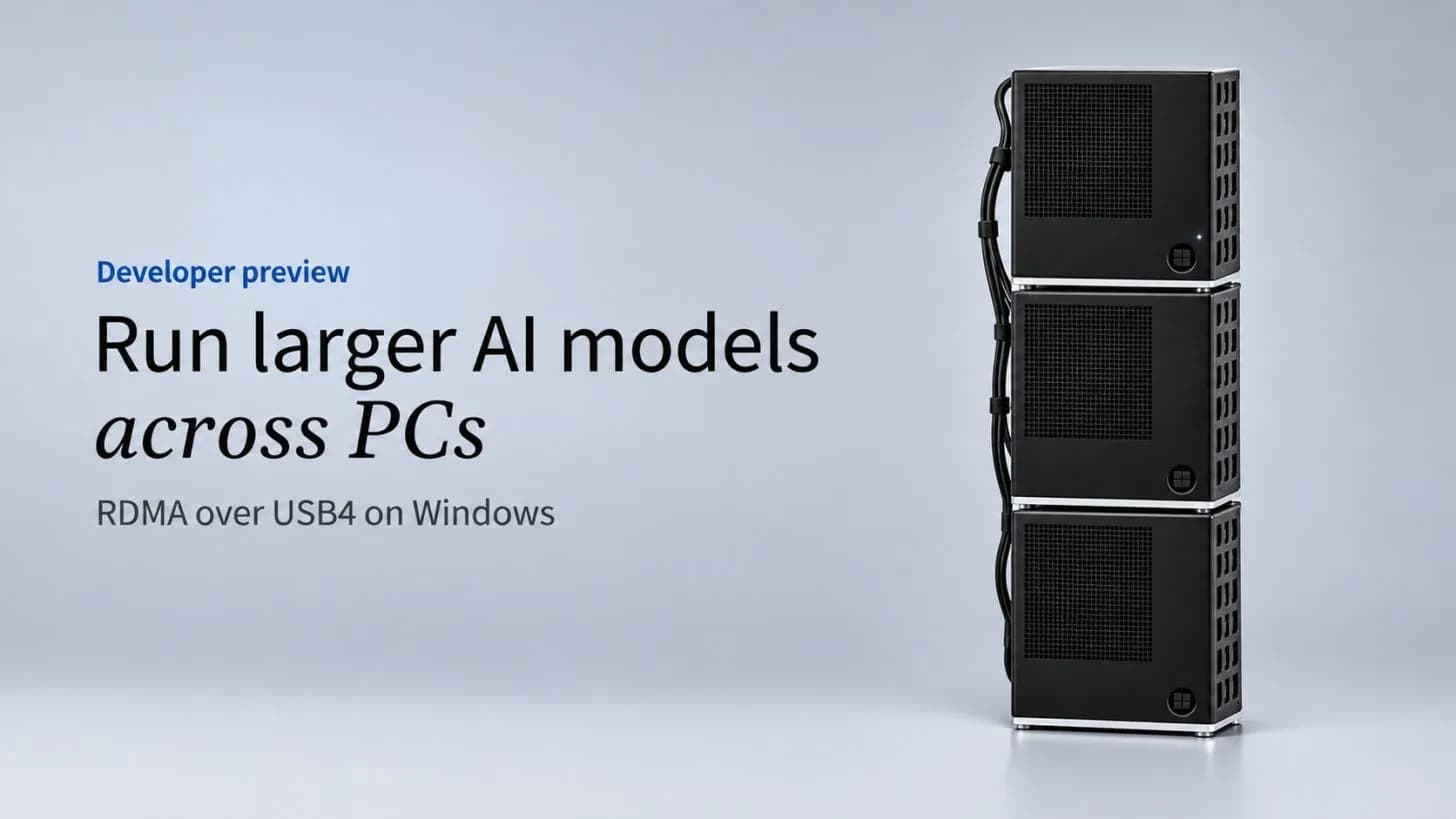

Be the first to comment
Join the argument. No password, just your email or a passkey.