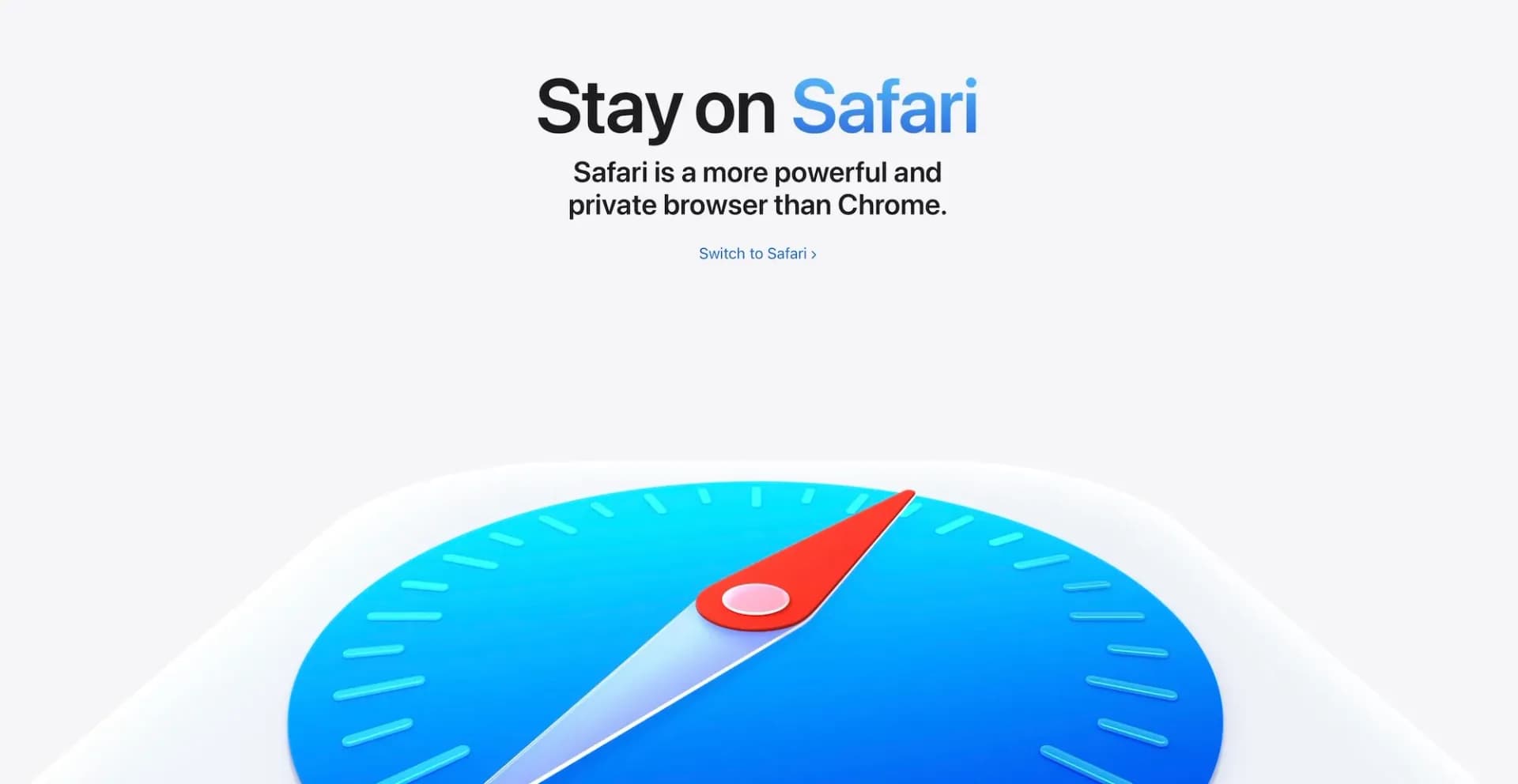
Apple is going after Google Chrome on its home turf. With a marketing push dubbed "Stay on Safari," the company is telling Mac owners that sticking with its preinstalled browser will give them up to five more hours of video playback before their battery runs flat.
Apple pairs that battery projection with a speed claim, asserting that Safari opens frequently visited destinations up to 35 percent faster than Google's rival on a Mac.
The figures come straight out of Apple's testing labs, and the fine print matters. Apple ran its page-load tests across cached offline builds of a dozen popular web pages over simulated connections. The hardware involved was a 15-inch MacBook Air running an M5 processor alongside 16GB of unified memory.
Those conditions do not translate to an automatic 35 percent speed bump across the broader internet or on older Intel hardware. Streaming video also stresses hardware differently than juggling twenty active tabs inside complex web apps. Apple's five-hour battery bonus specifically covers video streaming rather than general office work.
Chrome still commands the broader landscape. Chrome accounts for 66.36 percent of global browser activity, while Safari holds 18.27 percent, according to StatCounter tallies. Because Apple controls both macOS and the underlying WebKit engine, engineers can tune Safari directly around the media decoders and memory pathways of Apple silicon. Chrome relies on Chromium, whose multi-process architecture often draws criticism from users for consuming excessive amounts of RAM.
Google has also invited scrutiny over its recent browser additions, including an automated background download of a 4GB Gemini Nano machine-learning model.
Apple is leaning heavily on default privacy protections to win converts. Safari ships with Intelligent Tracking Prevention turned on out of the box and blocks third-party tracking cookies without requiring users to tweak settings. Features like Reader Mode, custom user profiles, and native Apple Pay checkout also tie directly into the broader ecosystem.
Yet Chrome has practical strengths that ad campaigns struggle to breach. The library of Chrome extensions remains massive, and browser sync links Windows desktops and Android handsets directly. For anyone hopping between an office PC and a personal Mac, leaving that multi-platform workflow behind is a tough ask.
Apple is betting that tangible battery savings will convince nomadic laptop users to rethink their default software. Whether five extra hours of video outweighs an indispensable browser extension will depend on how far each user roams from a wall outlet.
CDFiled by The Computing Desk
Laptops, desktops, processors, graphics cards and the operating systems that run on them.
More from this desk →

Be the first to comment
Join the argument. No password, just your email or a passkey.