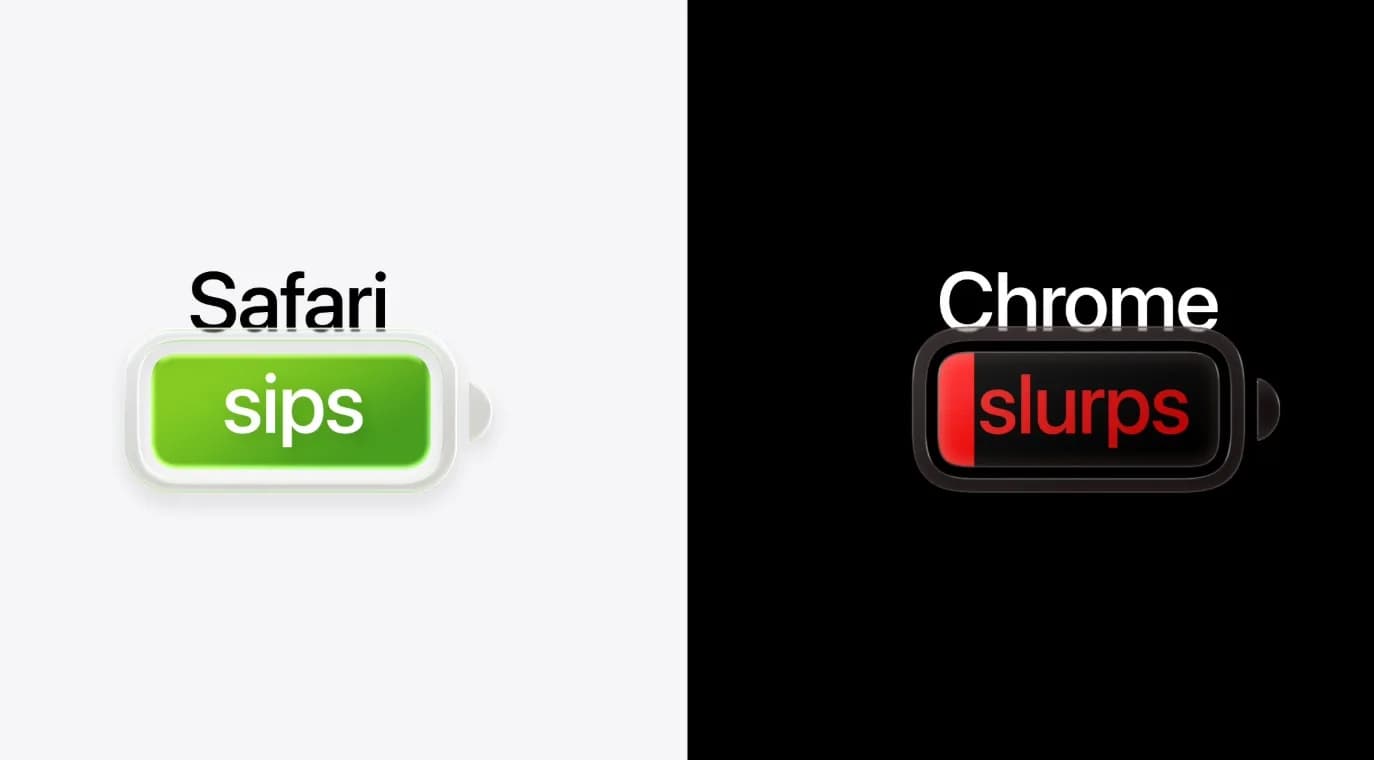
Apple has launched a new campaign telling Mac users to stop using Chrome — and says sticking with Safari could give them up to five extra hours of video streaming battery life. The push, called “Stay on Safari”, is live now across Apple’s Mac support pages and marketing channels in the US and India. It’s not a software update. It’s a pitch, sharp, specific, and built entirely around three claims: battery life, speed, and privacy. All three are measured under narrow conditions, and all three hinge on what you’re doing and how you’re doing it. That matters. Because Chrome still holds two-thirds of the global browser market. Safari sits at just over 18%. So this isn’t about winning over casual switchers. It’s about nudging power users who stream video for hours, open dozens of tabs daily, or care deeply about cross-site tracking. And who happen to own an M5 MacBook Air. Apple tested its battery claim on a 15-inch MacBook Air with an M5 chip and 16GB of unified memory, streaming video over Wi-Fi. Five extra hours is the maximum observed, not a guaranteed uplift for Zoom calls, coding, or multitasking. Its speed claim is similarly bounded: Safari loaded 12 popular websites up to 35% faster than Chrome on that same M5 Air, under simulated network conditions. Not every site. Not every Mac. Not every connection. Privacy is where the comparison holds more universally. Safari blocks third-party cookies by default and runs Intelligent Tracking Prevention out of the box. Features Chrome only began rolling out selectively in 2024, and still doesn’t enable by default. Reader Mode, Profiles, and native Apple Pay integration are also highlighted as differentiators. But Chrome’s advantages remain practical, not theoretical. Its extension library is vastly larger. Sync works across Windows, Android, iOS, and Linux. If your workflow depends on a specific Chrome extension, or if you toggle between a Dell laptop and a Mac daily. Safari’s optimizations won’t fix that friction. The campaign doesn’t mention price, because there isn’t one. Safari is free. Chrome is free. What’s being sold isn’t a product, it’s a trade-off. Efficiency for ecosystem lock-in. Speed for compatibility. Privacy for convenience. Apple’s message lands in the US and India at the same time. No regional pricing, no staggered rollout. Just a single, targeted nudge. Aimed squarely at people who type ‘chrome extensions’ into Google while their MacBook Air battery ticks below 20%.
Chrome extensions vs Safari: Apple promises 5 extra hours battery life
Apple’s new 'Stay on Safari' campaign promises up to five extra hours of video streaming battery life—but only under tightly controlled test conditions.
The Computing Desk · (4 hours ago)
Reported from
How this story was made
Written by the Hitechreports desk from the reporting credited above, with facts attributed to their original publishers. We do not test devices ourselves; anything about performance, battery life or cameras comes from the outlets that did. Prices are as reported at the time of writing. Editorial policy · Report an error
Filed by The Computing Desk
Laptops, desktops, processors, graphics cards and the operating systems that run on them.
More from this desk →Read next
More Laptops & PCs →
Apple Targets Chrome Download Habits With Bold Mac Battery Claims
Apple is pitching Mac users on battery life, claiming Safari provides up to five extra hours of video streaming and 35 percent faster page loading compared to Google Chrome.
HomePod mini 2 Mac System Audio Support
The HomePod mini 2 can now pipe Mac system sounds — notifications, alerts, UI feedback — directly through the speaker. It requires a Wi-Fi 6E Mac (2023 or newer) and a future macOS Golden Gate update.

Apple Links Idle Mac GPUs to Run Internal AI Workloads
Apple researchers revealed Minions, a distributed platform that taps idle Apple Silicon GPUs on internal macOS machines to execute machine learning inference workloads, cutting job queue delays from hours to minutes.
Be the first to comment
Join the argument. No password, just your email or a passkey.