Grab customers in Bali can now have restaurant orders flown between venues by automated aircraft. A new pilot project in the Indonesian province is shuttling meals over populated districts between Café del Mar Bali and Nuanu Creative City, a 44-hectare site dedicated to culture, wellness, innovation and community.
Flights are handled by SKYY Network, while the aircraft and ground support hardware come from California-based A2Z Drone Delivery. Rather than staging a one-off demonstration, the companies want to test how autonomous aviation slots into an active commercial delivery network.
Indonesia's Directorate General of Civil Aviation cleared the pilot after putting the plan through a Specific Operations Risk Assessment process. That gave the team approval for beyond-visual-line-of-sight operations, making this the first BVLOS food delivery route in Indonesia. The flights also navigate controlled airspace tied to Bali's Ngurah Rai International Airport, adding tight air traffic coordination to the mix.
Weather and geography make the corridor unusually difficult. Southern Bali blends busy tourist areas with dense local population pockets, rough terrain, spotty connectivity, and unpredictable coastal winds that can push lightweight multirotors around.
To handle those hazards, A2Z deployed its Longtail Dual aircraft. The design includes two independent battery packs so the craft can maintain flight control and land safely if one battery drops offline in mid-air. On the ground, the aircraft pairs with A2Z's AirDock stations. These enclosures automate landing, recovery, and battery charging without requiring an attendant to manually reset the craft after every hop. A2Z points to an equal one-to-one ratio between flight time and charging time, which curtails ground delays between runs. Automated docks could eventually let operators run fleets across wide territories with minimal on-site staff.
Grab insists the aircraft will not sideline human couriers. The platform plans to use the technology in a hybrid structure, deploying drones across specific choke points or long stretches while gig workers handle the legs that demand ground-level flexibility.
Food delivery serves as the initial trial run. If the route holds up through variable weather and everyday operational strains, A2Z wants to use the AirDock framework for industrial tasks. The company is eyeing offshore transport, ship-to-shore supply runs, site inspections, and emergency medical support. For now, the focus stays on proving meals can move across Bali's airspace safely and repeatedly.
GDFiled by The Gadgets Desk
Audio, wearables, cameras, tablets, chargers and every other device worth carrying or plugging in.
More from this desk →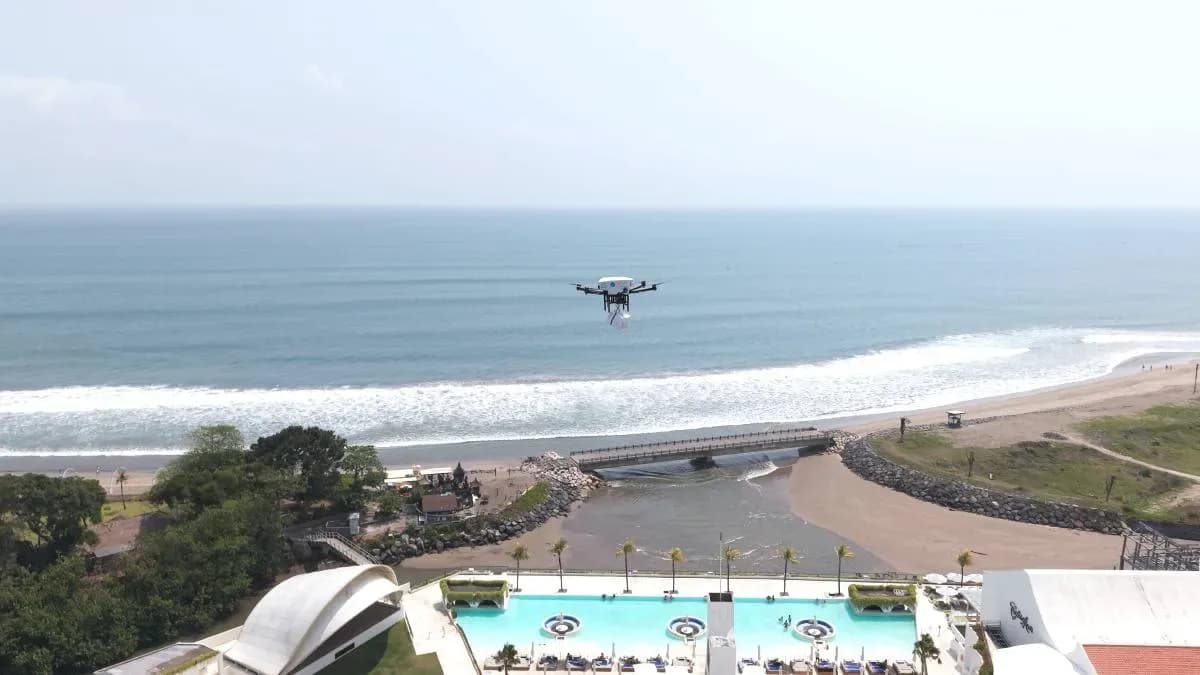
Be the first to comment
Join the argument. No password, just your email or a passkey.