Skip to content
Trending
Cameras2 min read

Casio Camera Division Shutdown: How the QV-10, Exilim, and Tryx Built the Future

Casio didn’t fade from cameras. It built the future — then watched it arrive in everyone’s pocket.

Where to buy · 2 products

Paid links. As an Amazon Associate, Hitechreports earns from qualifying purchases. We also earn a commission from eBay and Temu on purchases made through our links. Prices change; the story gives the price as reported when it was written.

By The Gadget Shelf

The Gadgets Desk · (3 hours ago)

Reported fromoutlet, credited1
Casio QV-10 digital camera, 1995, with visible rear LCD screen
Casio QV-10 digital camera, 1995, with visible rear LCD screenPhoto via Digital Camera World

Casio exited the digital camera business in 2018 — not after a slow fade, but after a 23-year run defined by three distinct leaps forward. Its first was the QV-10, launched in March 1995: the world’s first consumer-grade digital camera with a rear LCD for previewing and reviewing images. That 250,000-pixel device featured a 1.8-inch screen and cost ¥65,000, nearly $700 at the time.

It sounded ordinary in hindsight, but in 1995 it was revolutionary. Casio sold around 200,000 units in its first year alone. The company wasn’t a camera maker by origin. Founded in 1946 by the Kashio brothers, it began with the ‘Yubiwa pipe’, a finger ring that held cigarettes, then moved into desktop calculators in the 1950s, pocket calculators in the 1970s, and digital watches in 1974.

Its real advantage was miniaturization: low-power integrated circuits, LCD displays, compact keyboards and miniature electronics, all honed in watches and calculators, then applied to imaging. That expertise led directly to its second major contribution: the Exilim line, launched in 2002. Starting with the ultra-thin EX-S1, Casio pitched these as ‘wearable card cameras’, devices small enough to carry constantly, not just when you planned to shoot.

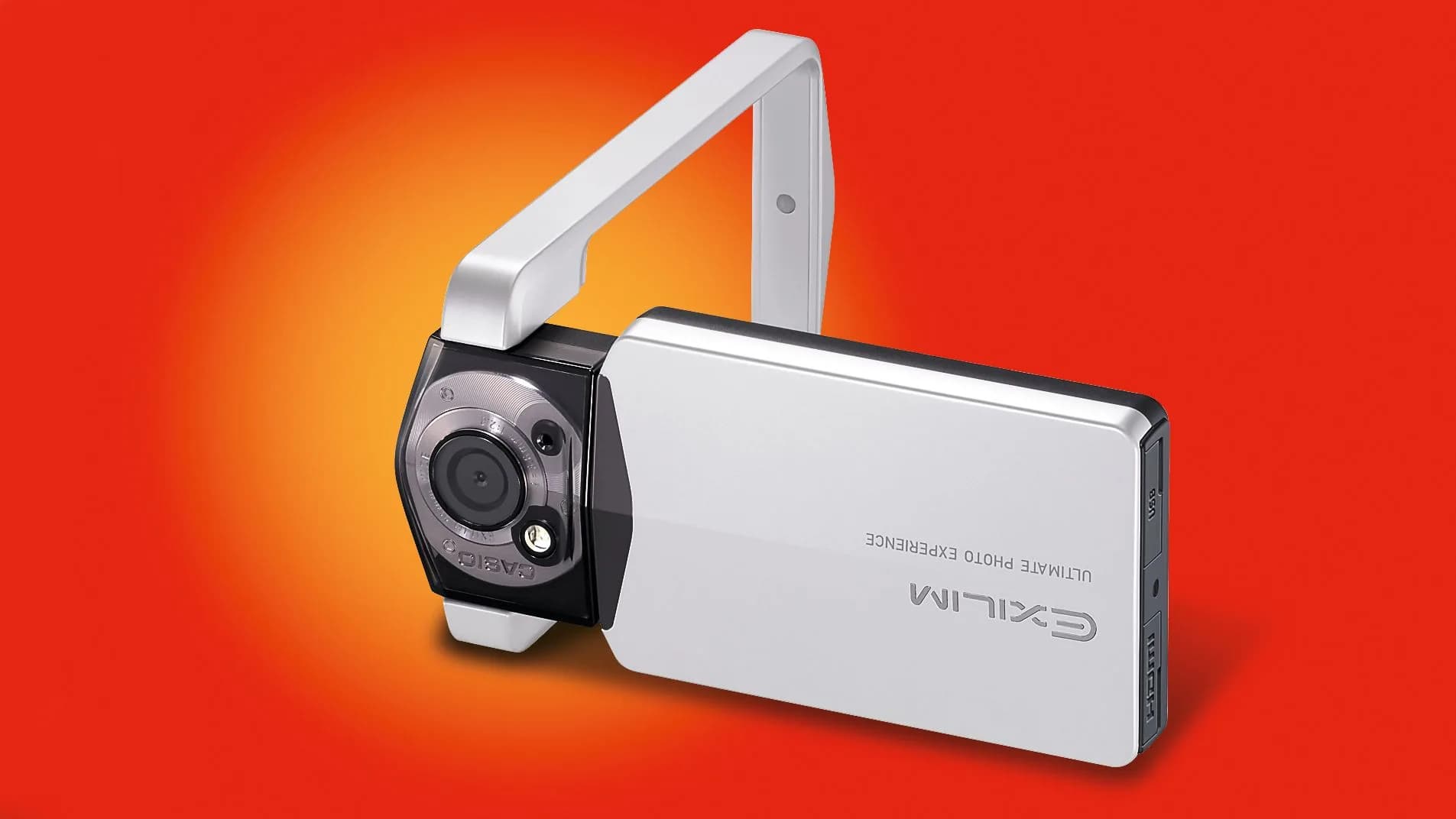
They were fast to start, fast to operate, and stylishly thin. Then came the third pivot: the 2011 EX-TR100, sold in North America as the Tryx. Its screen and frame rotated into multiple positions, letting it stand on a table, hang from a strap, or point easily at its owner.

At first, it didn’t catch on. But after photos taken with it went viral via a Hong Kong fashion model, demand surged across China and Southeast Asia. Casio itself says the camera earned the nickname, roughly translated, of the ‘goddess selfie device’, and almost single-handedly ignited the selfie craze. By 2017, however, Casio’s camera division lost ¥500 million, about $4.5 million at 2017 exchange rates.

Unlike Canon, Nikon or Sony, Casio had no professional or semi-professional camera lines to fall back on. No interchangeable lenses. No larger sensors. So in 2018, after 23 mostly successful years, it stopped making cameras entirely.

Its final product wasn’t obsolete. It was preempted.

Where to buy · 2 products

Paid links. As an Amazon Associate, Hitechreports earns from qualifying purchases. We also earn a commission from eBay and Temu on purchases made through our links. Prices change; the story gives the price as reported when it was written.

Reported from

How this story was made

Written by the Hitechreports desk from the reporting credited above, with facts attributed to their original publishers. We do not test devices ourselves; anything about performance, battery life or cameras comes from the outlets that did. Prices are as reported at the time of writing. Editorial policy · Report an error

What did you make of it?

Filed by The Gadgets Desk

Audio, wearables, cameras, tablets, chargers and every other device worth carrying or plugging in.

More from this desk →

Be the first to comment

Join the argument. No password, just your email or a passkey.