Gigabyte is pairing AMD's desktop-grade 3D V-Cache silicon with top-tier Nvidia discrete graphics in its latest flagship portable. The company's new Aorus Master 16 Gen 2 arrives with the 16-core AMD Ryzen 9 9950HX3D, offering options for either an Nvidia GeForce RTX 5080 or an RTX 5090.
Prices start at $3,399.99 in the US on Amazon for the RTX 5080 configuration, which ships with 32GB of DDR5 memory and a 1TB SSD. Stepping up to the RTX 5090 model bumps storage to 2TB and pushes the price tag to $4,799.99.
Silicon and Thermal Design
At the center of both machines is the Ryzen 9 9950HX3D. The processor runs 16 cores, hits boost clocks of up to 5.40GHz, carries a 140W TDP, and packs 128MB of L3 cache to feed frame-heavy titles. Graphical workloads fall to Nvidia's latest architecture, with the RTX 5080 carrying 16GB of GDDR7 memory and the RTX 5090 packing 24GB of GDDR7 VRAM.
Dissipating that much hardware requires serious airflow. Gigabyte fitted the chassis with its Windforce Infinity EX thermal system, rated to handle up to 230W of total heat output. The system uses a vapor chamber offering 50 percent more coverage than prior builds, along with 0.075mm copper fins and four exhaust exits. Twin Frost Fan 2.0 blowers use 160 asymmetric blades that are 40 percent thinner, accompanied by internal acoustic diffusers designed to keep whine in check.
Display, Ports and Upgrades
Visuals run on a 16-inch OLED panel built around a 16:10 aspect ratio and a 2,560 x 1,600 resolution. The screen features a 240Hz refresh rate, a 0.2ms response time, 100 percent DCI-P3 gamut coverage, and a VESA DisplayHDR True Black 1000 rating.
Unlike several thin machines that solder components down, memory and storage remain accessible. Buyers get two SODIMM slots accepting up to 64GB of DDR5 RAM. Internal drive bays include one PCIe Gen 5 NVMe slot alongside a second PCIe Gen 4 SSD slot.
Power comes via a 99Whr battery supporting Power Delivery 3.0, which Gigabyte says charges to 50 percent in 30 minutes over AC power. Wireless is handled by Wi-Fi 7 capable of speeds up to 46Gbps, alongside an FHD 1080p infrared webcam for Windows Hello logins.
I/O spreads across both flanks. The left edge houses a USB-A 3.2 Gen 2 port, a USB-C 3.2 Gen 2 connection with DisplayPort 2.0, a microSD slot, and a 3.5mm audio jack. The right side holds the barrel plug, RJ-45 Ethernet, an HDMI 2.1 socket, an additional USB-A port, and a USB4 Type-C connector with DisplayPort 1.4 output.
Both configurations are available immediately from US retailers.
CDFiled by The Computing Desk
Laptops, desktops, processors, graphics cards and the operating systems that run on them.
More from this desk →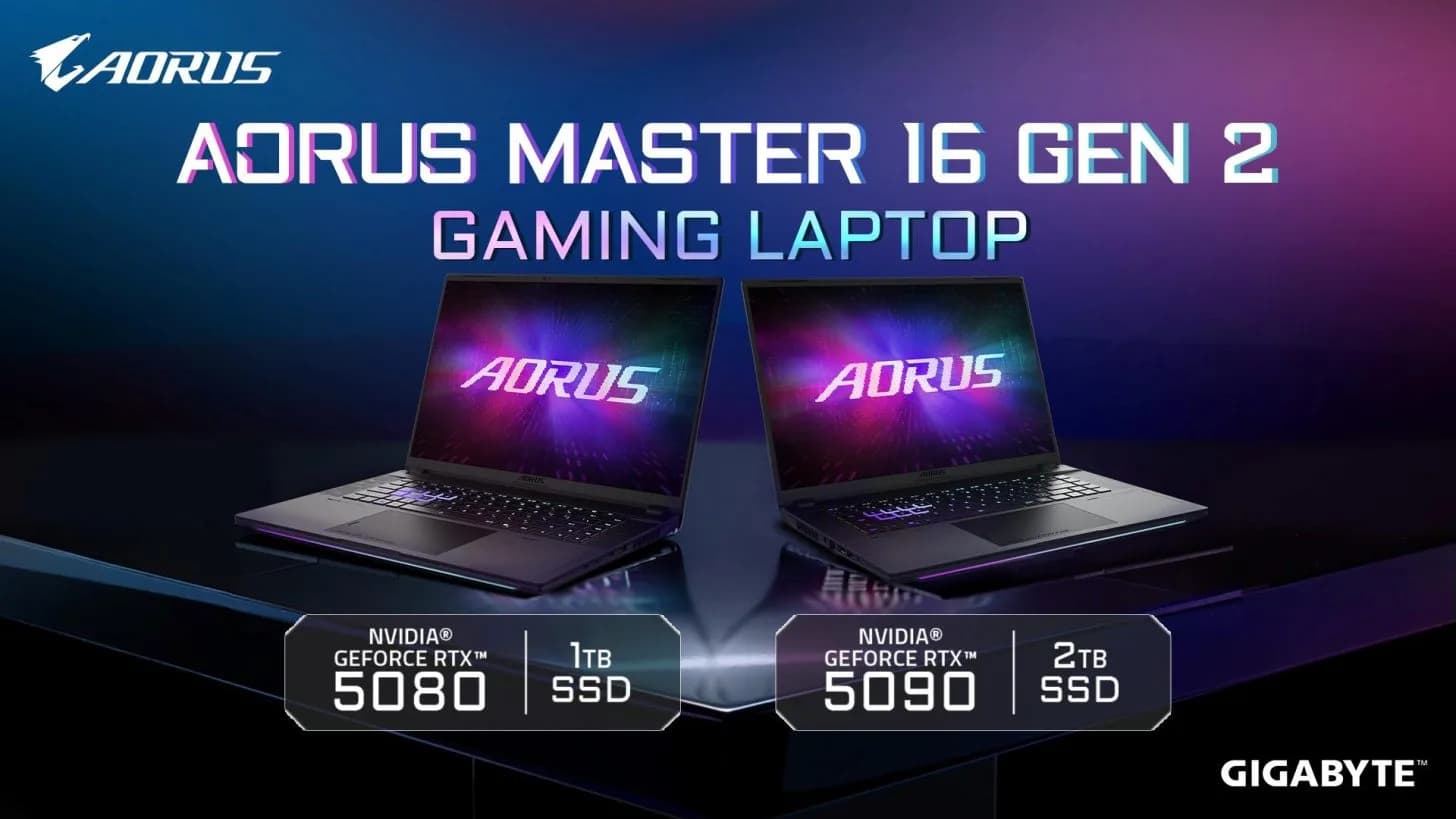

Be the first to comment
Join the argument. No password, just your email or a passkey.