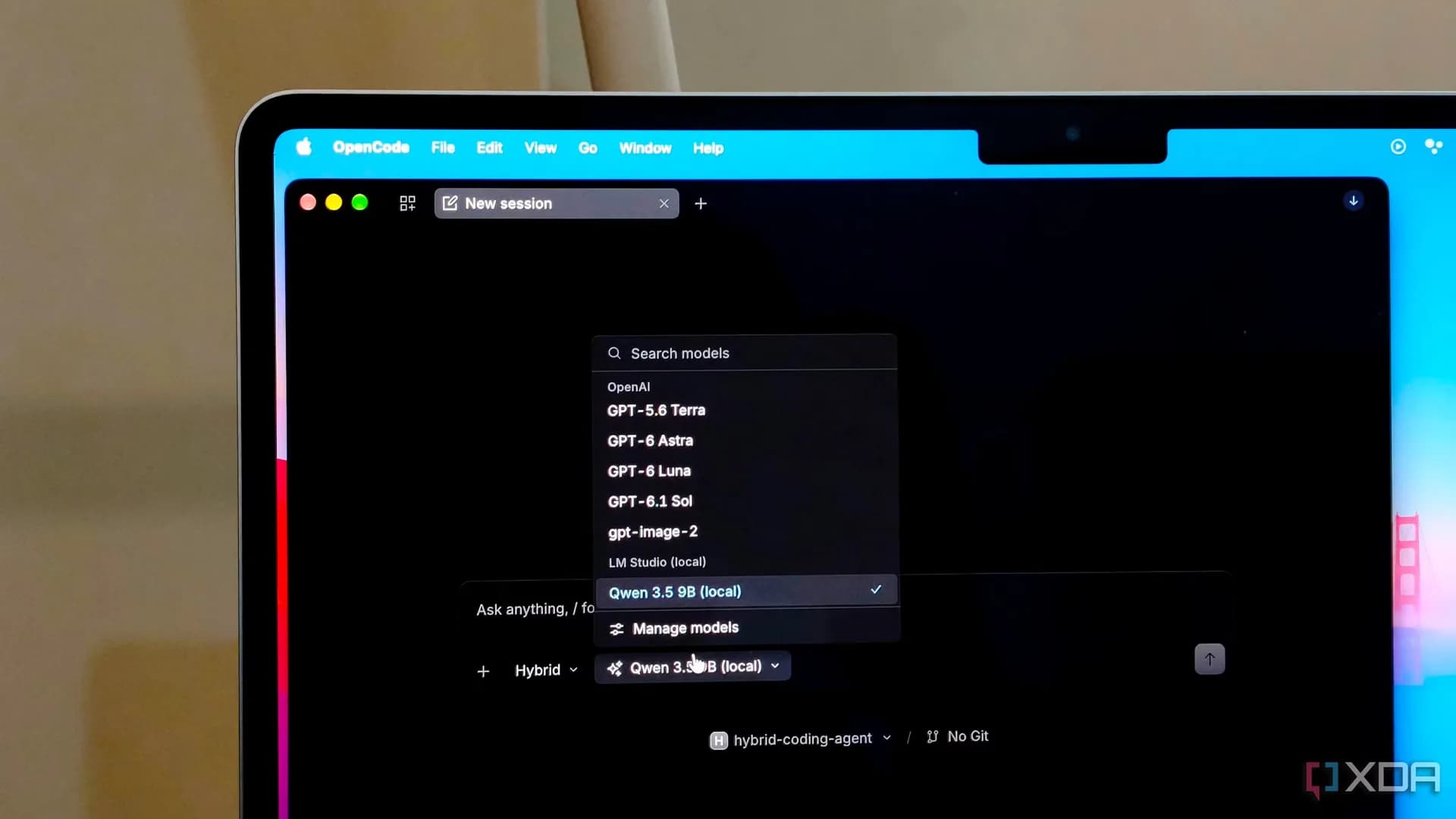
A developer has connected a local LLM running on a Mac to Gmail, Google Calendar, and Home Assistant — using open protocol standards, and found it meaningfully useful for daily tasks without sending prompts or data to the cloud. The setup relies on Model Context Protocol (MCP), a tool-interfacing standard that lets local AI models call external services through dedicated connectors. It does not replace Google’s own assistant. It bypasses it entirely. And keeps control local. } { “I’m finally seeing how useful it can be without sending my data out,” the developer writes on XDA Developers. } { MCP isn’t new, but its adoption is accelerating. LM Studio, the desktop app used here. Supports it out of the box. Adding an MCP server for Google Workspace gives the model access to Gmail search and calendar read functions. A separate Home Assistant MCP Server exposes lights, scripts, and device states. Both require manual authorization: users log into their Google account and grant API permissions. Home Assistant needs its own integration enabled. } { The model doesn’t just know your schedule, it checks it. Ask it to propose a meeting time, and it pulls the thread from Gmail, scans your calendar for availability, then drafts a reply with slots that don’t conflict. It won’t auto-create events unless explicitly instructed and granted write permissions. And even then, the user reviews every draft before sending. } { Same for home control. “Shut down the house” triggers a prebuilt Home Assistant script, no model logic needed for timing or sequencing. But “Turn off the lights, but leave the bathroom light on” forces interpretation: the model must identify devices by name, query current states, and call the right toggle commands. That only works if devices are clearly labeled and exposed in the MCP server. } { Not all models handle tools reliably. The post notes that success depends on both the connector’s capabilities and the model’s ability to select, parameterize, and chain operations. A known weakness in smaller local models. Still, the author reports few corrections needed in early use, and says a 9B-parameter model handled OpenCode integration well enough to build custom tools. } { This isn’t a product. There’s no app store listing, no version number, no support channel. It’s a working proof-of-concept built with LM Studio, community-maintained MCP servers, and existing APIs. No Android or iOS support is mentioned. No cloud inference is involved, except where Google’s own services are required (e.g., fetching Gmail threads). } { What changes now? Nothing, officially. But the pieces are public, interoperable, and getting easier to assemble. MCP servers for Notion, Obsidian, and GitHub are already in development. If more apps expose MCP-compatible endpoints. And more desktop LLM tools ship with built-in support, this kind of local orchestration stops being a hack and becomes a baseline expectation. } { Next step: wider testing. The XDA post links to the Google Workspace MCP and Home Assistant MCP Server repos. Both are open source. Both require technical setup. Neither is aimed at consumers. But they’re live. And they work. }
Local LLMs + MCP = Gmail, Calendar, Home Assistant Control
No cloud. No tracking. Just Gmail, Calendar, and Home Assistant — all wired into a local LLM via open protocols.
By Clock Speed
The Computing Desk · (2 hours ago)
Reported from
How this story was made
Written by the Hitechreports desk from the reporting credited above, with facts attributed to their original publishers. We do not test devices ourselves; anything about performance, battery life or cameras comes from the outlets that did. Prices are as reported at the time of writing. Editorial policy · Report an error
Filed by The Computing Desk
Laptops, desktops, processors, graphics cards and the operating systems that run on them.
More from this desk →Read next
More Laptops & PCs →
Claude Haiku 5.5: Free for Everyone, 90% Cheaper for Developers
Claude Haiku 5.5 is live globally: free for all users, 90% cheaper for developers, and benchmarked by Anthropic against GPT-6 Luna — though independent verification is still pending.
Claude Haiku 5.5 Is Live: Fastest, Cheapest Anthropic Model Yet
Anthropic has launched Claude Haiku 5.5 — its fastest and cheapest model yet, priced at $0.10 per million input tokens in the US, with a 1-million-token context window. It’s live globally as of Tuesday, October 8, 2026.
Google Calendar in Android Auto Routes Drives Directly Through Google Maps
Google Calendar entries with saved addresses can launch routing directly in Google Maps on Android Auto, letting drivers trigger trips through dashboard taps or Gemini voice prompts.
Be the first to comment
Join the argument. No password, just your email or a passkey.