OpenAI pushed out GPT-6.1 Terra on Monday, a fast model built for visual reasoning, computer use and writing that's now live in the API as gpt-6.1-terra and in ChatGPT for Plus, Pro, Enterprise and Edu users. It replaces GPT-5.6 Terra, and it comes in a lot cheaper than the rest of OpenAI's current lineup.
Standard API pricing is $1 per million input tokens and $5 per million output tokens, with cached input at $0.05 per million. That's half what GPT-6.1 Sol charges ($2/$10) and a tenth of GPT-6 Astra's rate ($10/$50). Claude Opus 5.5 lists at $4/$20 for comparison. Batch and Flex processing knock another 50% off, while Fast mode doubles the standard rate. Prompts longer than 272,000 input tokens bill at 2x input and 1.5x output.
Terra takes text and images and returns text, with a 1,050,000-token context window and up to 128,000 tokens of output. Its knowledge cutoff is June 1, 2026. Reasoning effort is adjustable from none to max, medium by default, and tool calling runs through the Responses API with support for computer use, hosted shell, code interpreter, web search, file search and MCP. OpenAI points to matching product photos against catalog entries and reading technical drawings as example jobs.
Where it lands against the rest of the lineup
On Agents' Last Exam v1, OpenAI's set of professional computer tasks, Terra scores 57.6% at medium effort for $0.29 per task. GPT-5.6 Terra managed 42.6% at $0.84. GPT-6 Astra hits the same 57.6% score but costs $4.82 per task to get there. Push Terra to max effort and it reaches 60.0% at $1.01 per task, against Claude Opus 5.5's 63.2% at $8.82. OpenAI says Terra finishes these tasks more than three times faster than both Astra and Sol.
The pattern holds on other benchmarks. On OSWorld 2.1, Terra scores 66.7% at medium and 74.2% at max, trailing Sol's 78.0%, Astra's 80.9% and Claude Sonnet 5.5's 83.9%, but clearing GPT-5.6 Terra's 57.1% ceiling by a wide margin. On MMMU-Pro's vision benchmark, Terra's 85.5% at max effort sits close to Sol (86.3%) and Astra (86.7%), and that run costs $0.012 per task against $0.065 for Astra.
On an internal set of error-inducing prompts, Terra's error rate at low effort dropped from 53.6% to 16.7%, and fell to 4.3% at max effort, an 18-point improvement. The set is adversarial by design, so OpenAI cautions that production error rates will look different.
Coding is the weak spot. On Terminal-Bench 4.0, Terra solves 50.3% of tasks at max effort, up sharply from GPT-5.6 Terra's 21.5%, but still behind Sol (55.9%), Astra (58.2%) and Claude Sonnet 5.5 (70.6%). OpenAI itself steers developers toward Sol or Astra for the hardest coding work. Terra does edge out Sol on Terminal-Bench-Science 0.1, scoring 58.3% at $4.15 per task against Sol's 57.0% at $5.47.
All of the benchmark figures and per-task costs are OpenAI's own self-reported numbers from its launch materials, not independent testing. For teams running high volumes of screen-reading or document-parsing agents, the pitch is straightforward: scores close to the pricier models, at a fraction of the bill.
ADFiled by The AI Desk
Models, assistants and the companies and chips behind them, reported from what was released and what was claimed, with the difference kept clear.
More from this desk →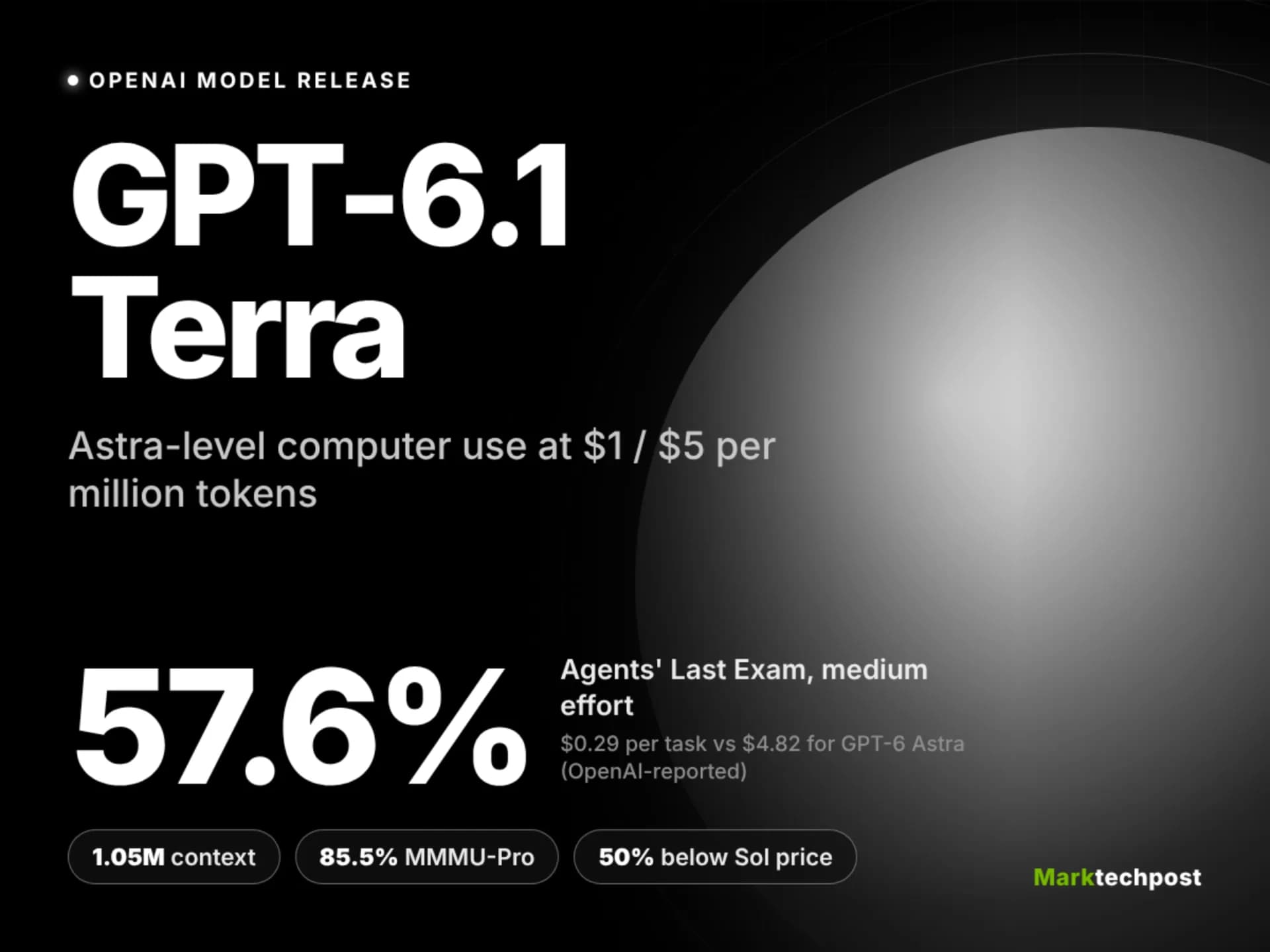

Be the first to comment
Join the argument. No password, just your email or a passkey.