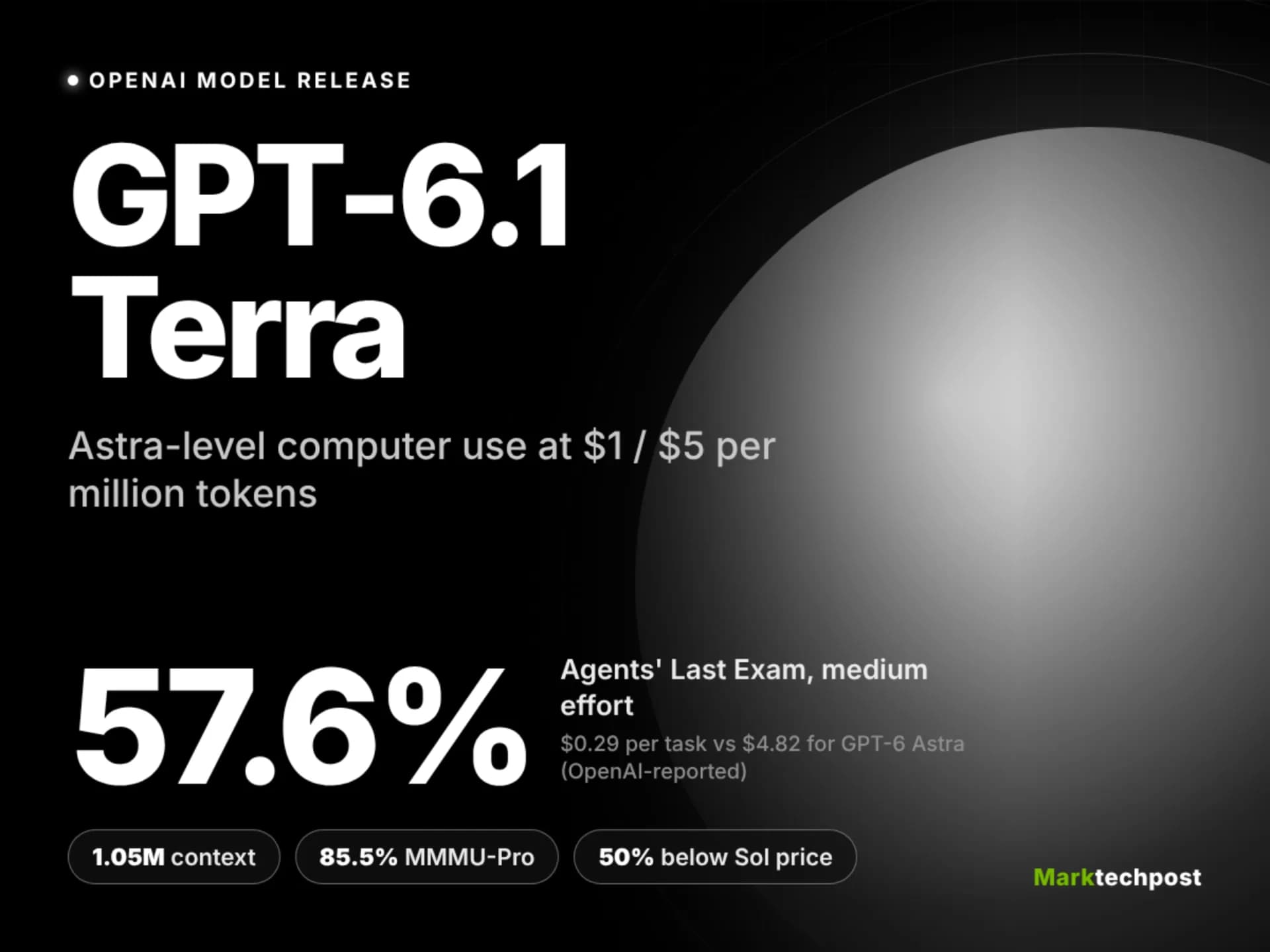
OpenAI pushed out GPT-6.1 Terra on October 26, a model built around what the company calls computer use, the ability of an AI agent to click through software, fill out forms and interpret documents rather than just answer text prompts. It replaces GPT-5.6 Terra and is live now for Plus, Pro, Enterprise and Edu subscribers inside ChatGPT Work and Codex, OpenAI said in a blog post. Developers can call it through the API using the identifier gpt-6.1-terra.
OpenAI is pitching Terra at workday tasks it says the old model struggled to finish quickly: drafting proposals, turning architectural drawings into 3D models, reading invoices and keying the numbers into accounting software, editing video. On Agents' Last Exam, a benchmark built around exactly that kind of multistep professional work, OpenAI says Terra scores 15 percentage points higher than GPT-5.6 Terra at medium reasoning effort, while costing roughly a third as much to run. The company also claims it matches GPT-6 Astra, its more expensive flagship, at one-tenth the price per token, and finishes tasks more than three times faster than both GPT-6 Astra and GPT-6.1 Sol.
OpenAI ran its own comparison against Anthropic's Claude Opus 5.5 too. At maximum reasoning effort, the company says Terra is more than three times as token-efficient and costs about a quarter as much per token, working out to roughly nine times cheaper per completed task. All of these figures come from OpenAI's internal testing, not an independent lab, so they're worth treating as a vendor's claim rather than settled fact.
Fewer wrong answers, better coding scores
Factual accuracy was apparently a focus. On OpenAI's internal benchmark of prompts designed to trigger hallucinations, Terra's error rate at low reasoning effort fell to 16.7%, down from 53.6% for GPT-5.6 Terra. At maximum effort the rate dropped 18 percentage points to 4.3%, which OpenAI says puts it close to GPT-6 Astra and GPT-6.1 Sol.
Coding improved as well. On Terminal-Bench 4.0, which tests command-line coding agents on jobs like fixing a webpage whose layout breaks while it loads, Terra solved 50.3% of tasks at maximum effort against 21.5% for its predecessor. OpenAI still points developers toward GPT-6.1 Sol or GPT-6 Astra for the hardest coding work, so Terra reads as the fast, cheap option rather than the top one.
On visual reasoning, measured by the MMMU-Pro benchmark, Terra beat GPT-5.6 Terra at every reasoning setting and came close to GPT-6 Astra and GPT-6.1 Sol scores at a lower cost. On OSWorld 2.1, which scores how well an agent operates desktop software across multiple steps, Terra topped GPT-5.6 Terra's best recorded result for a fraction of the price per task.
OpenAI says the model clears the Critical threshold for cybersecurity risk under its Preparedness Framework, the internal system it uses to grade how dangerous a model could be if misused, and carries over the safeguards built for GPT-6 Astra. The company also reports improved resistance to prompt-injection attempts, where hidden instructions try to hijack an agent mid-task, with details published in Terra's system card.
Standard API pricing lands at $1 per million input tokens, $0.05 per million cached input tokens and $5 per million output tokens, which OpenAI says is half of what GPT-5.6 Terra and GPT-6.1 Sol cost. The company hasn't said whether Terra will reach the free ChatGPT tier, and no Indian rupee pricing has been published for the API or the ChatGPT Work plans the model ships on.
ADFiled by The AI Desk
Models, assistants and the companies and chips behind them, reported from what was released and what was claimed, with the difference kept clear.
More from this desk →
Be the first to comment
Join the argument. No password, just your email or a passkey.