LiberNT is live — not as a rumor, leak, or beta teaser, but as downloadable bootable disk images and open-source code on GitHub. The operating system positions itself squarely as a free, GPL-licensed alternative to Windows 11, designed to run Windows-compatible applications on modern 64-bit hardware: amd64, arm64, and riscv64.
Its name is literal: Liber (free), NT (New Technology architecture). And yes, it’s vibe coded. But not in the way you might assume. “AI is part of how LiberNT is built,” its GitHub page states.
“It helps us review and write code… Before anything reaches the main branch, a person runs and validates the end-to-end tests.” No auto-merged LLM output. Just human-reviewed, AI-assisted development. LiberNT is not ReactOS. It began as a fork, but the team says it has since replaced the boot loader, graphics stack, memory manager, and, as of yesterday, the kernel.
“LiberNT is not affiliated with or endorsed by the ReactOS project or Microsoft,” the developers emphasize. That distinction matters. This isn’t an evolution of an old compatibility layer. It’s a ground-up rebuild aimed at stability, reliability, and efficiency, not nostalgia.
Benchmark results published by the team are striking, and narrow in scope. They tested LiberNT against Windows 11 on identical hardware: a Mac with an Apple M3 Pro chip. Across 132 system-level tests covering file caching, memory handling, thread scheduling, locks, FAT32, and NTFS performance, LiberNT outperformed Windows 11 in 112 cases.
The worst result? A 28% deficit. The best? Over 2000% faster, in specific low-level operations.
These are not app-launch times or gaming frame rates. They’re kernel and driver subsystem metrics: how fast pages are allocated, how efficiently caches sync, how tightly locks serialize access. Real-world desktop responsiveness isn’t measured here. Neither is compatibility with Win32 or.NET apps, though the project’s stated goal is to support them.
There are no prices. No licensing tiers. No subscription. It’s free, open, and built to be modified.
You can download prebuilt ISOs now. You can clone the repo. You can compile it yourself, if your toolchain supports amd64, arm64, or riscv64. What it isn’t, yet, is a drop-in replacement for Windows 11 on your laptop.
The Tom’s Hardware reporter notes he plans to test Firefox, Word, and an old Photoshop release, but those tests haven’t been reported. No outlet has verified app compatibility, driver support, or daily-driver stability. This is day one of a long road. Still, the timing is sharp.
With Android 17 removing Bluetooth volume controls, Google tightening Play Store policies, and Linux distributions still wrestling with consumer hardware support, LiberNT arrives not as a curiosity, but as a deliberate, licensed, and technically ambitious counterweight. Its first builds are out. Its first kernel is merged. Its first benchmarks are public.
Now comes the hard part: making it work, for real.
CDFiled by The Computing Desk
Laptops, desktops, processors, graphics cards and the operating systems that run on them.
More from this desk →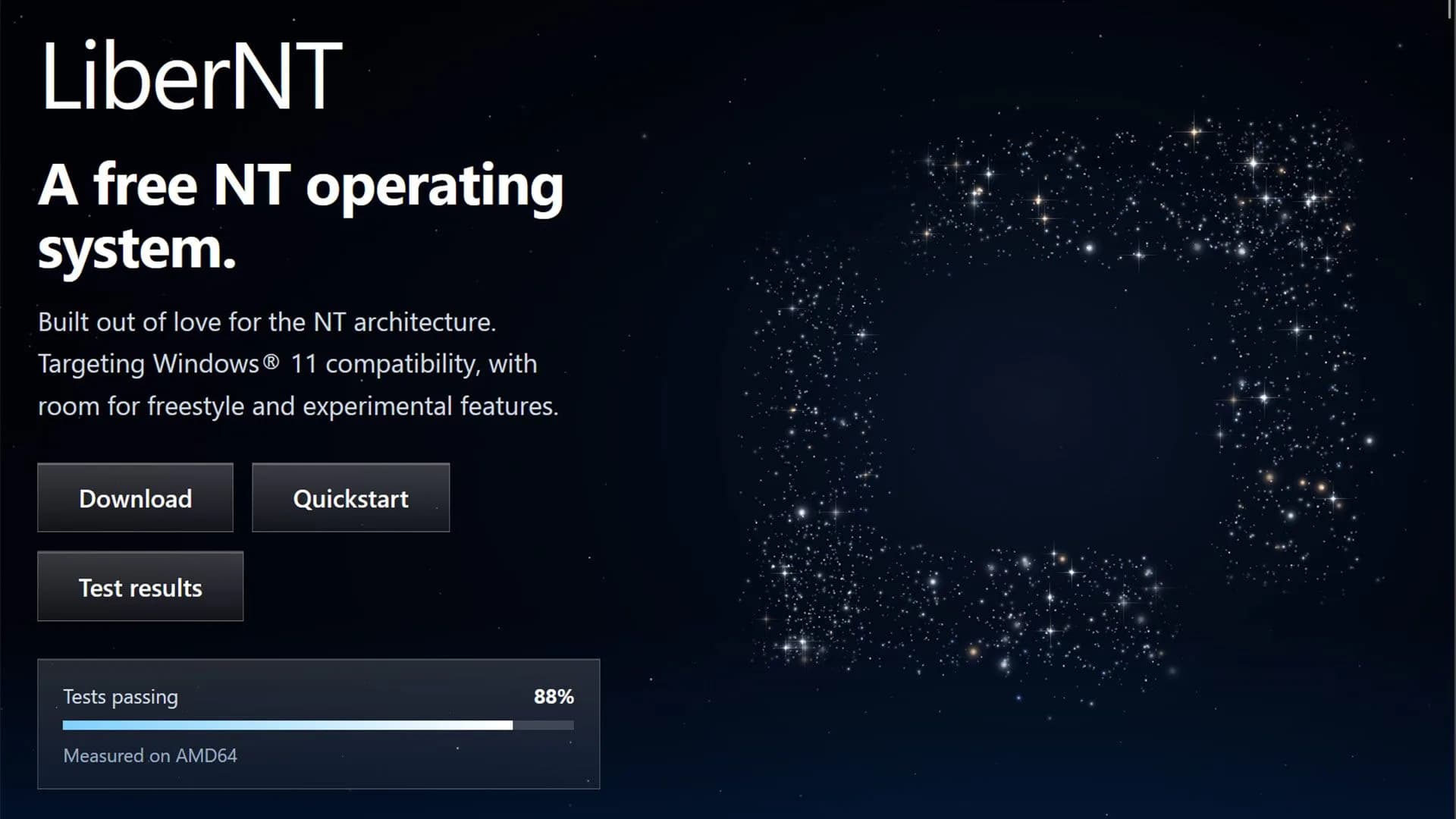
Be the first to comment
Join the argument. No password, just your email or a passkey.