Local AI on laptops usually hits a wall the moment large models choke on mobile VRAM. Nvidia's response is the RTX Spark, a unified system-on-chip combining a Grace CPU and a Blackwell GPU on TSMC's 3nm node. In an early review of the platform, Gizbot tested how the hardware manages agentic tasks locally, using autonomous software that directly controls system operations without cloud routing.
The silicon package connects up to 20 Grace CPU cores to an RTX Blackwell graphics processor across a bidirectional NVLink C2C connection running at 600GB/s. Because the interconnect treats system memory as a shared resource, configurations scaling up to 128GB of LPDDR5X allow the graphics hardware to address far more memory than typical mobile graphics cards. That unified pool enables local deployment of models that normally require dedicated desktop workstations or remote servers. Nvidia offers two silicon tiers, topped by an edition with 6,144 CUDA cores.
Hardware makers preparing machines with the chip include Dell with the XPS 16, Lenovo with the Yoga Pro 9, HP with the Omnibook Ultra 16, and MSI with the Prestige N16 Flip AI, alongside designs from Asus and Microsoft.
Gizbot's evaluation focused on the 6,144-core configuration running the open-source Hermes Agent. When instructed to download Google Chrome and assign it as the system's default browser, the agent handled OS settings and completed the transition without manual input. In another test, Gizbot directed the agent to sort a cluttered downloads directory by extension. The model evaluated the files for 30 seconds before filing them into separate subfolders autonomously. Because the models execute on local silicon, the tasks required no subscription APIs and processed data without an internet connection.
Beyond administrative tasks, the unified memory pool allows local fine-tuning of personal models alongside heavy creative workflows. Gizbot highlighted video and photo applications adapting to the platform. DaVinci Resolve features a native Arm build that uses the RTX architecture for local model acceleration after an initial setup step. In Gizbot's test, Hermes Agent installed Resolve, imported video and audio assets, and trimmed the soundtrack to match footage length.
Adobe is rebuilding Photoshop and Premiere Pro for the Spark architecture with GPU-accelerated betas. Premiere handles TensorRT functions such as speech enhancement, auto-framing, scene cuts, and subject tracking on the machine. In Photoshop, the remove tool cleans images locally rather than pinging cloud servers. For generative pipelines, ComfyUI integrates nodes that handle super-resolution, AI frame insertion, and SDR-to-HDR tone mapping in a single local pass.
Laptops carrying the RTX Spark superchip are scheduled to begin reaching retail shelves through hardware partners over the coming weeks.
CDFiled by The Computing Desk
Laptops, desktops, processors, graphics cards and the operating systems that run on them.
More from this desk →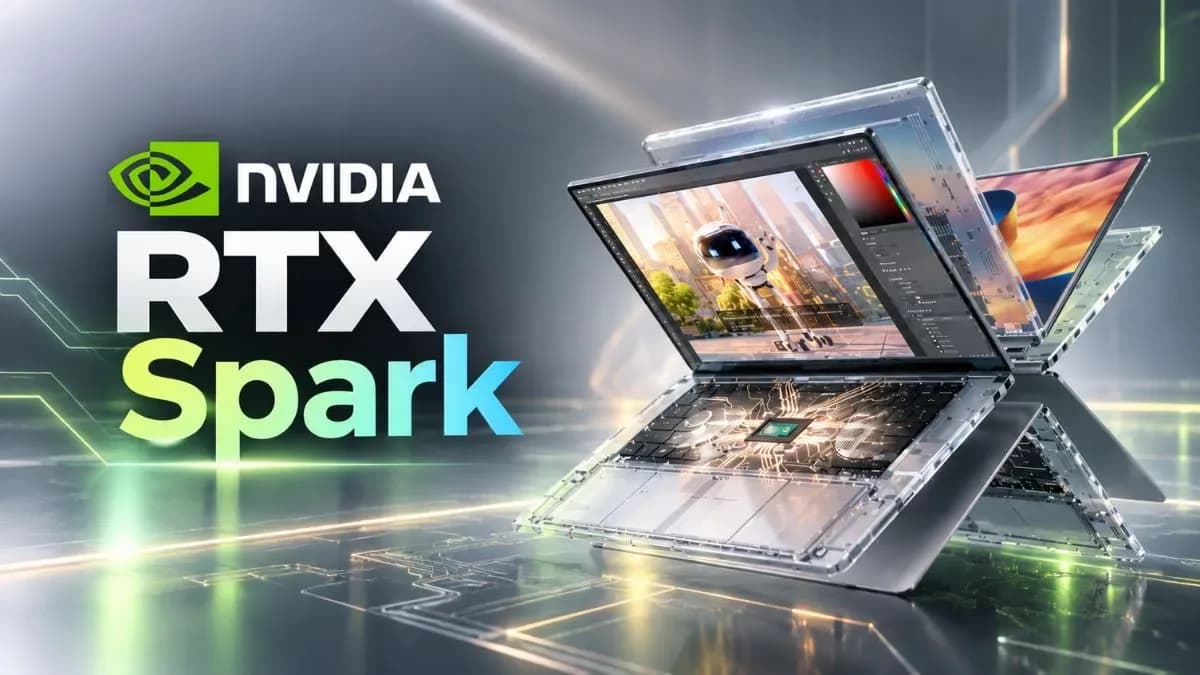
Be the first to comment
Join the argument. No password, just your email or a passkey.