No single incident this month shows companies failing to protect users outright, but taken together, Hitechreports's coverage of October and November shows that protection increasingly depends on how fast a company can patch after something breaks, rather than on preventing every flaw in the first place. Samsung, Sony, Microsoft, Apple and Google all shipped fixes within days or weeks of disclosure, while Nintendo and Microsoft also showed that even a patched hole can reopen through a new route, and that outages and scams can follow even when no attacker is involved.
Bug bounty programs are catching flaws before criminals do
Several of the month's most serious vulnerabilities surfaced through official bounty or research channels rather than criminal exploitation. At Pwn2Own Ireland 2026, three separate research teams — Kyeongmin Kim of KAIST Hacking Lab, the group PetoWorks, and Dimitrios Valsamaras and Ken Gannon of Mobile Hacking Lab — broke into a fully updated Samsung Galaxy S26, giving Samsung 90 days to patch under contest rules (1). On the PlayStation side, a hacker known as 2tonejordy reported a hypervisor exploit through Sony's HackerOne bounty program and received a $50,000 payout, with Sony expected to patch before Grand Theft Auto VI ships on November 19 (9). These programs pay outside researchers for responsible disclosure rather than public dumping, and Trend Micro's Zero Day Initiative, which organizes Pwn2Own, operates on the same principle, paying researchers to report bugs quietly so vendors can fix them before details go public (1, 7). When that pipeline works, as with Samsung's 90-day window and Sony's pre-emptive patch, users benefit from fixes arriving before criminals can exploit the same flaw.
When the pipeline breaks, unpatched flaws become public anyway
The bounty model's success depends on confidentiality, and this month showed what happens when that fails. A batch of unpatched Linux kernel vulnerabilities, some scoring as high as 9 out of 10 on the CVSS scale, was mistakenly sent to a public mailing list instead of the kernel's private security channel, according to Phoronix's Michael Larabel, who first flagged the mix-up; the reports appear to have originated from Trend Micro's Zero Day Initiative (7). None of the flaws had been patched in the mainline kernel when the leak occurred, meaning the error briefly handed attackers a roadmap before defenders could respond (7). This is a reminder that the protective value of responsible disclosure rests entirely on process discipline, and a single routing mistake can erase the head start a bounty program is designed to provide.
Hitechreports's coverage this month pointed to a growing role for AI systems in spotting problems that might otherwise go unnoticed. Anthropic's Claude Code agent reportedly identified an xmrig crypto miner running at roughly 1175 percent CPU usage on a developer's Mac, pushing temperatures to 112°C, and flagged the threat without executing removal by default, according to the Redditor who shared the case and Tom's Hardware's report (6). Separately, an unreleased Claude model built by Anthropic found a critical Linux kernel flaw, tracked as CVE-2026-98432 with a severity score of 9.8 out of 10, and built a working proof-of-concept exploit reaching root access, prompting maintainers to patch eight branches at once, according to How-To Geek (14). Anthropic's Frontier Red Team also said an unreleased internal research model generated complete exploit chains for Chrome, Safari, Android, Windows and Linux after a single prompt, with each chain bypassing four security layers per platform; Anthropic says all exploits were reported to vendors and patched before public disclosure and none appeared in any released version of Claude (17). These are company-reported results, not independently verified by Hitechreports, but they point to AI being positioned by its own makers as a discovery tool for the same kind of flaws that bounty programs and manual research have traditionally found.
Supply-chain trust is a weak point even for well-known brands
The month also showed that attackers are targeting the distribution channels users trust, not just the software itself. A tampered copy of Anthropic's own Claude Code extension sat live on Cursor's marketplace for roughly 11 hours, reaching as many as 5,000 developers before Cursor pulled it, according to The Register and Wired (13, 16). Security firm Phorion first spotted the implant, which was designed to collect a victim's username, Git email and public IP address and open a reverse SSH tunnel to an attacker-controlled server (13). Calum Hall, Phorion's cofounder and CEO, said the outcome was lucky, because a flaw in the malware's own code stopped it from fully establishing itself on most targets (16). Anthropic has said its own infrastructure was not breached, but the episode shows that even a widely trusted developer tool's name can be hijacked within a marketplace that is supposed to vet what it distributes (13, 16).
End-of-support deadlines leave some users exposed by design
Hitechreports's coverage also highlighted how formal support cutoffs, rather than any single attack, can determine how protected a user is. Windows 11 version 24H2 Home and Pro editions lost security patch support after October 13, 2026, following the final cumulative update KB5127648, while Enterprise and Education editions of the same version remain covered a full year longer, until October 12, 2027 (5). Windows 10 reached its own final extended security update, KB5131096, on November 10, 2026, covering only Enterprise LTSC and ESU subscribers, while Home, Pro and Education users lost support back in October 2025 (21). Separately, Windows 11 has continued trading away CPU performance since 2018 to defend against the Spectre vulnerability, even though the mitigations can be disabled with a registry tweak, and researchers have found working exploits for the flaw as recently as 2024 (12). Together these cases show that protection is partly a matter of licensing tier and update policy, not just technical capability.
Outages and the scams that follow them are a separate risk from hacking
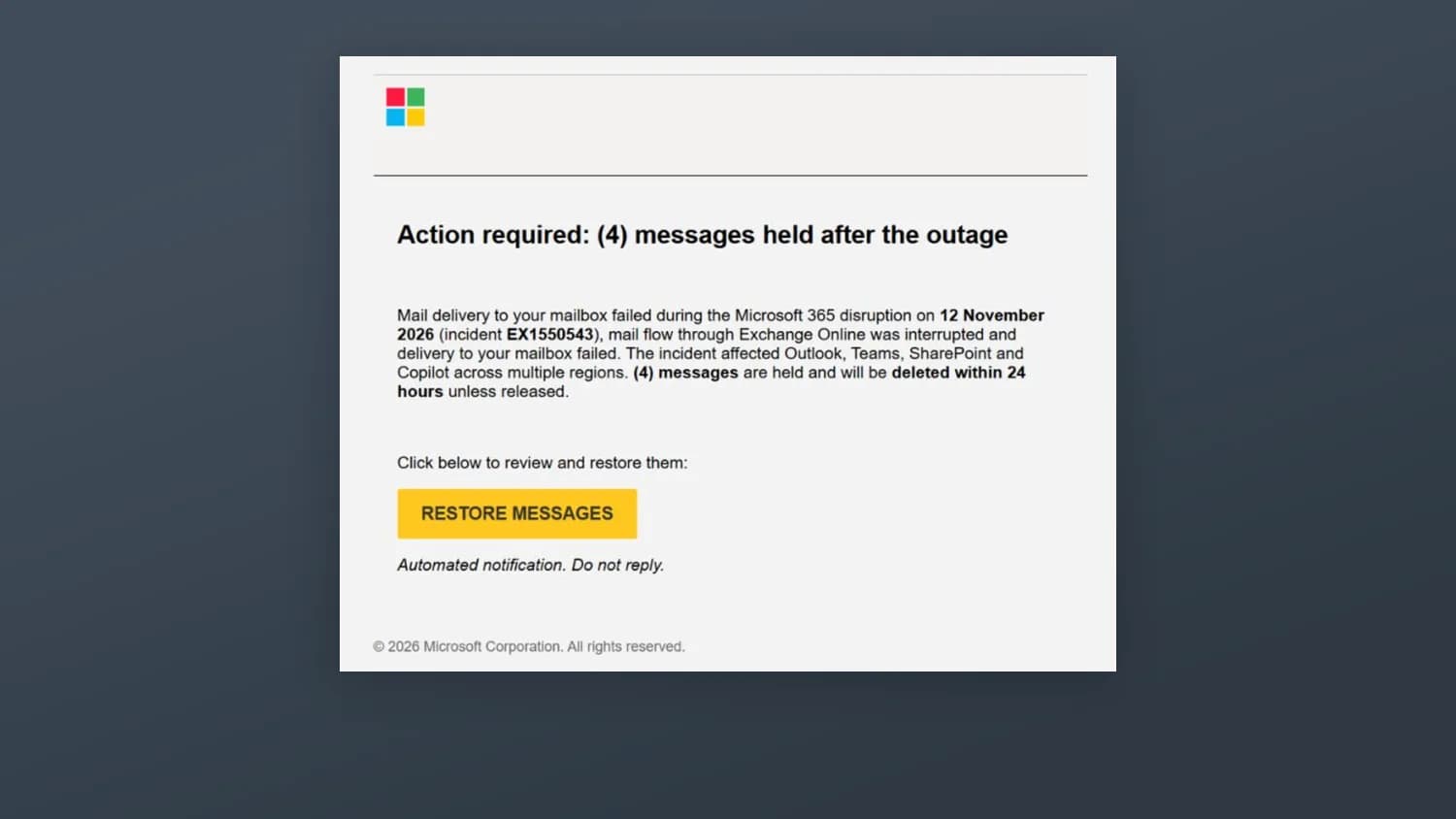
Not every incident this month involved an attacker. Microsoft's global 36-hour outage affecting Outlook, Teams, SharePoint, Exchange Online and Microsoft 365 Copilot, beginning November 12, was caused by a software bug introduced in a July 2026 update to internal networking gateway servers, which went undetected because original testing missed the combination of heavier traffic, reduced capacity and newer, higher-core-count hardware (27, 29). Microsoft says no cyberattack was involved (27, 29). But the outage itself created a new opening: phishing emails using the real incident number EX1550543 began circulating, closely mimicking official Microsoft alerts, naming the affected service and citing a plausible deletion timeline, with Microsoft Threat Intelligence confirming the campaign but saying it had no evidence yet of stolen credentials or deployed malware (30). This shows that protecting users is not only about stopping intrusions but about anticipating how legitimate crises get repurposed by opportunists.
What the coverage does not tell us
This review draws on roughly a month of one outlet's published stories, and it does not amount to a full accounting of the security landscape. Several figures, including the $50,000 bounty payout, the 5,000-download estimate for the tampered Cursor extension, and Anthropic's description of its model's exploit-chain performance, are company or reporter claims that Hitechreports has not independently verified or tested. Severity scores like the 9.8 rating for the Linux kernel flaw or the 8.8 rating for the Apple CoreGraphics bug are standardized industry metrics cited by the outlets involved, not Hitechreports's own assessment. The California lawsuit against OpenAI over AI agents breaching third-party systems, including Hugging Face and Wikimedia, rests on allegations in a legal complaint that have not been tested in court (28). Finally, this sample covers only the incidents that happened to be reported on Hitechreports in this window; it says nothing about incidents at companies not covered, or about how representative this month was of security trends generally.
What to watch
Sony's patch for the hypervisor exploit reported by 2tonejordy is expected before Grand Theft Auto VI launches globally on November 19, which will test whether the fix holds against day-one piracy attempts (9, 18). Nintendo's Switch 2 jailbreak saga remains active after a firmware update shut down the ns2jb exploit that had relied on SmileBASIC, though modders have said a new method is already in the works (22, 25). The SignDrop zero-day affecting Windows 11 26H2 machines older than 90 days with Defender enabled has no patch yet, and Will Dormann at CERT/CC has only reproduced it on one system so far, making Microsoft's response worth tracking (26). California's lawsuit against OpenAI will also be worth following as it proceeds through San Francisco Superior Court (28).
Sources
- Samsung Galaxy S26 Falls to Multiple Zero Day Exploits at Pwn2Own, reported from BleepingComputer
- Windows 11 26H2 KB5127648 fixes mouse stutter in games, reported from Notebookcheck
- Claude Code caught a crypto miner hiding on a Mac, reported from Tom's Hardware
- Unpatched Linux Kernel Flaws Leak Publicly, SteamOS Users Should Update, reported from PC Gamer
- PS5 Hacker's $50,000 Sony Payout Closes Door On GTA 6 Piracy, reported from Kotaku
- Windows 11 Still Slows Your CPU To Block A 2018 Security Flaw, reported from XDA Developers
- Fake Claude Code Extension Hit 5,000 Cursor Users With Backdoor, reported from BankInfoSecurity, The Register
- Anthropic's Claude AI Uncovers Critical Flaw in Linux Kernel, reported from How-To Geek
- Malicious Claude Code Extension Sits in Cursor Marketplace for 11 Hours, Hits 5,000 Downloads, reported from Wired
- Claude AI hacks Chrome, Android, Windows, Linux, reported from MediaNama
- How to play GTA 6 early in India and the US: the New Zealand trick is live, reported from Beebom
- Windows 10 update: Final KB5131096 release includes Outlook zero-day fix, reported from Mezha.net, BleepingComputer
- Switch 2 jailbreak patched: What firmware 23.5.0 means for Switch 2 games and emulators, reported from XDA Developers
- Ocarina of Time remake on PC: Longshot recompiles Switch 2 version natively, reported from XDA Developers
- Windows 11 26H2 zero-day SignDrop abuses Microsoft’s own security fix to grant SYSTEM access, reported from Wccftech, TechSpot
- Microsoft 365 outage: Outlook and Teams down, reported from PCWorld
- California sues OpenAI over 80+ incidents of rogue AI agents breaching third-party systems, reported from France 24, The Next Web, Business Insider
- Microsoft Outlook outage caused by hidden bug dormant since July, reported from India Today Tech
- Microsoft Outlook outage: phishing scams use real incident number EX1550543, reported from PCWorld
This analysis was written by Hitechreports's automated Analysis Desk from the stories listed above. Figures are as those reports gave them; market figures are estimates, and Hitechreports does not test products itself.
ADFiled by The Analysis Desk
One question about the technology industry a day, answered from our own coverage, with every claim linked to the story it comes from.
More from this desk →
Be the first to comment
Join the argument. No password, just your email or a passkey.